Blogs
Magnesium Oxide for Silica Removal: One Mechanism, Two Applications
Magnesium Oxide for Silica Removal: One Mechanism, Two Applications
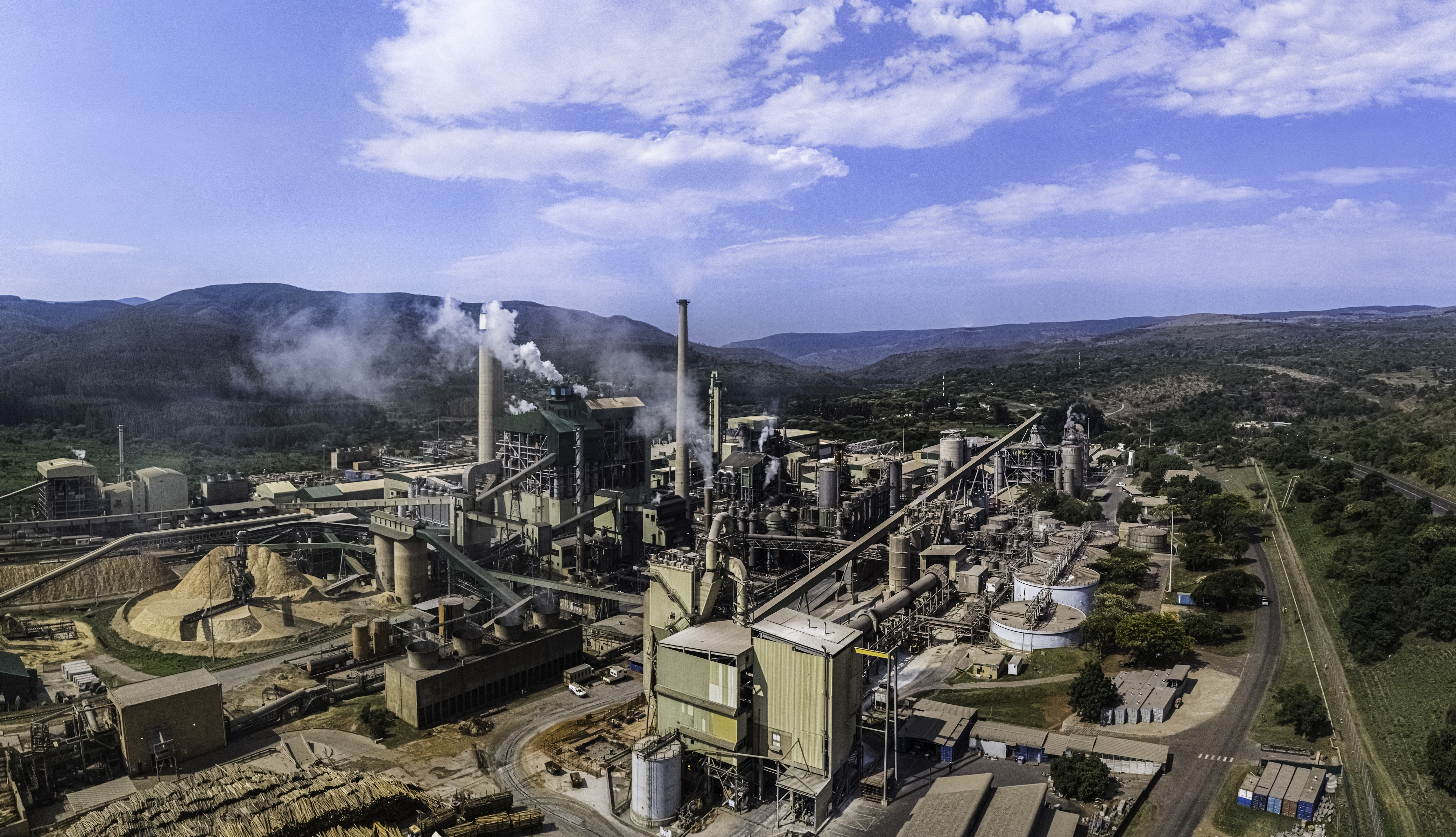
Silica is among the more difficult contaminants to manage in industrial water treatment. It is abundant in most raw and produced waters, chemically resistant to conventional removal methods, and prone to depositing on the hot surfaces of boilers, evaporators, and steam generators, where it forms a tenacious scale that impairs heat transfer. Removing reactive silica upstream of these surfaces is a recurring objective in boiler feedwater and produced-water treatment.
Two recent applications address this objective in different settings: a hot lime softener feeding a boiler at a paper mill, and a silica-reduction step ahead of an evaporator in an oil-sands steam-assisted gravity drainage (SAGD) operation. Although the waters and unit operations differ substantially, the governing chemistry is the same. In both cases the active agent is magnesium oxide.
Silica scale is also difficult to remove once formed. Unlike carbonate hardness, which responds to acid cleaning, silica deposits typically require hydrofluoric acid or aggressive caustic boil-outs. On the steam side, silica can volatilize and carry over to deposit on turbine blades. Consequently, preventing silica from entering the system is generally more economical than removing the resulting deposits.
The removal capacity derives from magnesium hydroxide precipitated in situ, where its surface is reactive and available. Because that surface is most effective when it forms in contact with the silica-bearing water, common practice in the oil sands industry is to add MgO without pre-slaking, allowing hydration to occur in the process stream rather than beforehand (Zhang et al., 2021).
As a general relationship, the quantity of silica removed scales with the quantity of magnesium hydroxide formed. This is the basis for supplementing with a magnesium source when the native magnesium in the water is insufficient to meet a silica target: lime alone carries silica down only as far as the available magnesium permits, whereas MgO addition allows the magnesium dose to be set independently. The dose-response relationship is best established by bench testing on the actual water, because matrix effects — competing ions, temperature, and pH — shift the results.
Two operating variables are most influential:
- Temperature. Silica removal by magnesium is strongly favored by heat. Cold-process softening removes comparatively little silica, while hot-process softening, operated near or just above boiling under slight pressure, can reduce reactive silica to low residuals. Both reaction kinetics and adsorption equilibrium improve with temperature.
- Magnesium availability. A greater quantity of precipitated Mg(OH)2 provides more silica-scavenging surface, subject to diminishing returns. MgO addition is the lever that controls this variable.
When the native magnesium in the makeup water is insufficient, or when a change in raw water or in lime chemistry reduces the magnesium being precipitated, silica residuals increase and can exceed boiler feedwater specifications. Supplementing with a reactive magnesium source restores silica-removal capacity without over-liming or transferring the load to downstream demineralization. The outcome is lower silica entering the boiler, more stable feedwater chemistry, and reduced risk of silica carryover to the steam side.
A magnesium-based silica-reduction step upstream of the evaporator reduces dissolved reactive silica before it can concentrate and foul the evaporator surfaces. The elevated temperature of the produced water is advantageous, placing the chemistry in the regime where magnesium hydroxide scavenges silica efficiently. Reducing silica at this point extends run length between cleanings, stabilizes distillate quality, and protects downstream steam-generation equipment.
The reaction is identical to that in the paper mill application but applied to a different water and a different unit operation.
Grade selection is important. Silica removal depends on rapid hydration to a high-surface-area Mg(OH)2; Pettauer et al. (2024) identify specific surface area as the primary driver of the rate at which MgO converts to Mg(OH)2. This favors a reactive, lightburn (caustic-calcined) MgO produced at lower calcination temperatures, which preserves surface area and reactivity. Hard-burned or dead-burned grades, optimized for refractory stability, hydrate too slowly to develop the fresh, available surface the silica chemistry requires. Reactivity measures such as citric acid activity are used to confirm that a grade will perform.
For these applications, Martin Marietta Magnesia Specialties recommends MagChem®40, a high-purity lightburn magnesium oxide produced from magnesium-rich brine and dolomitic lime. Its published properties align directly with the requirements above: a typical MgO content of 98.4%, a specific surface area of 63 m²/g, and a Caustic Magnesia Activity (CMA) index test value of 8.0 seconds, indicating rapid hydration to magnesium hydroxide. A fine particle size (3–8 micron median, 99.9% passing 325 mesh) further increases the surface available for silica adsorption. In the paper mill evaluation below, these properties are the basis for comparison against the magnesium supplied by hydrated dolomitic lime, which is present at lower concentration and, where already hydrated, with less available reactive surface.
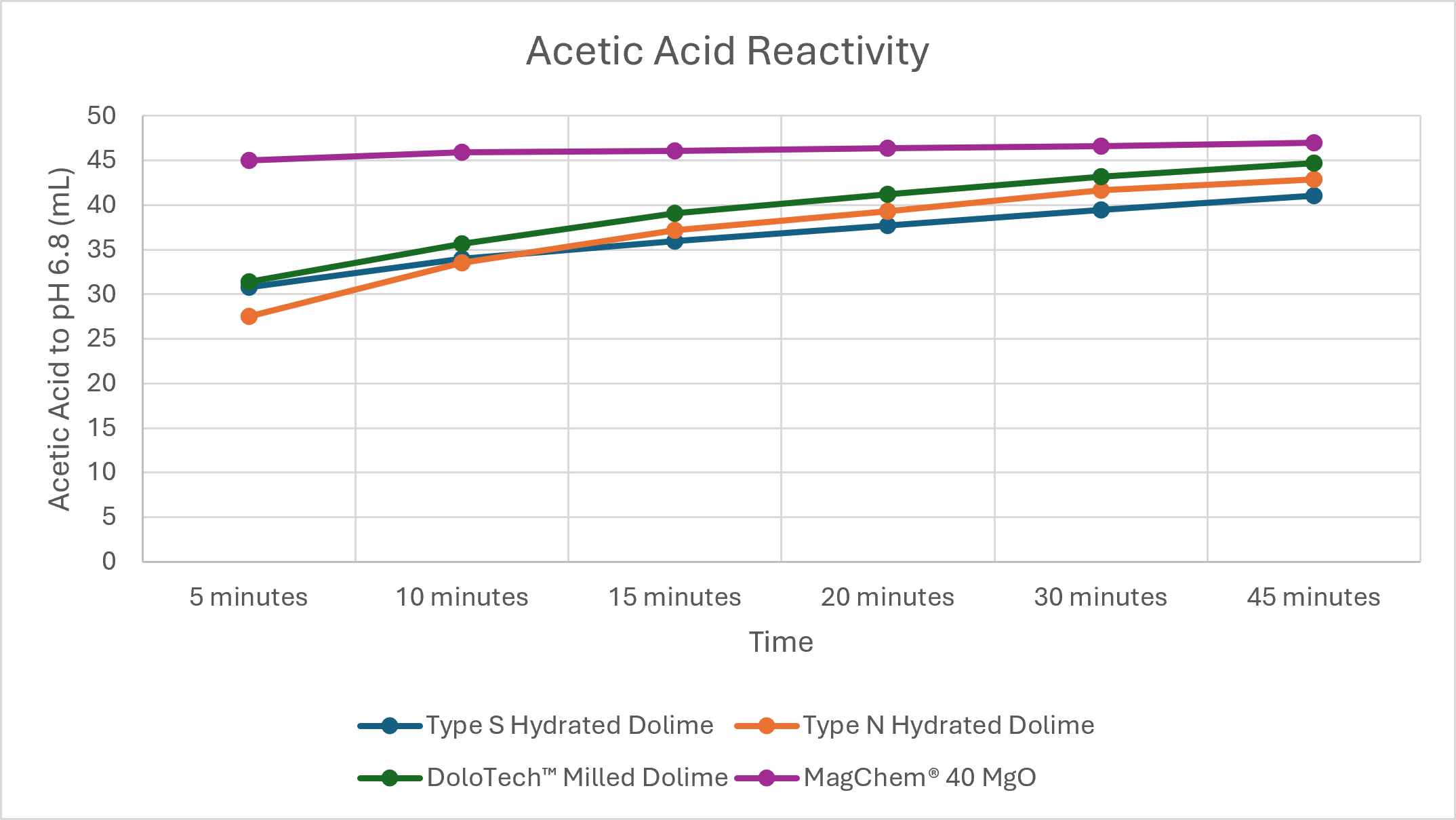
MagChem®40 was evaluated for reactivity versus Type N hydrated dolime, Type S hydrated dolime, and Martin Marietta’s DoloTech® milled dolime. In the acetic acid reactivity test, acetic acid is added to each of the products above to maintain a pH of 6.8. The greater quantity of acetic acid required, the greater the reactivity of the product. MagChem®40 was clearly the most reactive product, and DoloTech milled dolime also demonstrated superior reactivity versus hydrated dolomitic lime.
The same in-situ magnesium hydroxide chemistry that improves silica removal in a paper mill's hot lime softener applies to silica control ahead of a SAGD evaporator, despite the substantial differences between the two waters and process trains. With adequate temperature, sufficient reactive magnesium, and a dose confirmed by testing on the actual water, magnesium oxide provides a consistent and well-understood means of reducing reactive silica. A high-reactivity lightburn grade such as MagChem®40 supplies that magnesium efficiently, as the bench comparison against hydrated dolomitic lime illustrates.
Please reach out to Martin Marietta Specialties Division to speak to a technical expert or request a sample.
- Li, J., How, Z. T., Zeng, H., & Gamal El-Din, M. (2022). Treatment technologies for organics and silica removal in steam-assisted gravity drainage produced water: A comprehensive review. Energy & Fuels, 36(3), 1205–1231.
- Pettauer, M., Baldermann, A., Eder, S., & Dietzel, M. (2024). Hydration of MgO: Reaction kinetics and pH control on brucite crystal morphology. Crystal Growth & Design, 24(7), 3085–3092.
- Zhang, K., Pernitsky, D., Jafari, M., & Lu, Q. (2021). Effect of MgO slaking on silica removal during warm lime softening of SAGD produced water. Industrial & Engineering Chemistry Research, 60(4), 1839–1849.
For more information regarding your application or to place an order, please call 800-648-7400 (inside the U.S.) or +1-410-780-5500. Or, Contact Us with your questions.